


.jpg?width=230&height=32&name=BBRetail001-CMYK%20(1).jpg)
Private collectors or museums who lend their collections often have questions about employing a fine art courier:
- Do I need one?
- What role do couriers play in the art shipping process?
- What methods do they use to protect the artwork in transit?
- How do they overcome transportation challenges across long distances?
Depending on what you’re lending and where it’s going, a fine art courier can be a sound investment to protect your collection. Here’s an overview of what they do.
What kind of art needs a courier?
Certain types of fine art call for a courier to be present when moving artwork between two parties (museum to museum, collector to museum, or other loan scenarios). These may include:
- Irreplaceable artworks of historical or cultural significance
- Fragile, delicate, or complex-to-assemble art requiring particular handling
- Large-scale or oversized pieces
- High-value works in need of enhanced security
- Sensitive or controversial pieces
- Any artwork where the loan contract requires a human courier
The decision to involve a courier can depend on value, location-specific risks, legal considerations, specific handling requirements, and personal preferences.
Preparing for the journey
Ideally, well in advance of shipment, the courier and the borrower’s registrar begin meticulous planning. This entails a thorough dialogue regarding essential security and handling procedures, appropriate transportation arrangements, and logistics for every transition. The courier and registrar establish a comprehensive plan for managing documentation, including condition reports, and packing/crating details. The registrar identifies any insurance requirements related to the transport. The courier coordinates with the registrar throughout the entire process to maintain accurate records for all stakeholders.
Additionally, the courier and registrar, frequently in conjunction with a customs broker, discuss and manage pertinent regulations. They pay close attention to international shipping and customs requirements.
With the plan in place, the journey begins.
From a private collection to a museum
While every shipment is unique, the process typically involves:
Inspecting and packing fine art
Before packing begins, a registrar or courier conducts a thorough artwork inspection. This involves visually examining each piece, documenting its condition, taking photographs, and preparing detailed condition reports.
The courier then oversees the packing vendor as they prepare the items with appropriate packing materials for the loan and then crate the work. Couriers also monitor climate control measures to help prevent damage caused by temperature changes.
These meticulous procedures aim to safeguard the artwork's condition and minimize the risk of damage during transportation.
Transportation to and from
Registrars employ various transportation methods when moving artwork. They select these methods based on the nature of the piece, distance, logistical considerations, and the level of security required.
- Land: The courier transports the piece in specialized vehicles like climate-controlled trucks or vans. Ground travel provides direct courier control over handling and security, particularly for shorter distances.
- Air: The courier ensures artwork is carefully packed and transported in commercial flight cargo holds or dedicated art shipping services. This helps reduce risk of damage. Sometimes, couriers personally accompany the artwork during air transportation for continuous supervision and monitoring.
Throughout travel, couriers maintain clear and effective communication with multiple stakeholders involved in the transportation process, including the artwork’s owner, museum staff/registrar, customs officials, and transportation companies.
Unpack and install
Once they arrive at the museum, fine art couriers follow a systematic process to confirm proper handling and installation of the piece. They supervise the unpacking and then inspect the piece to assess its condition and compare it with pre-transportation documentation.
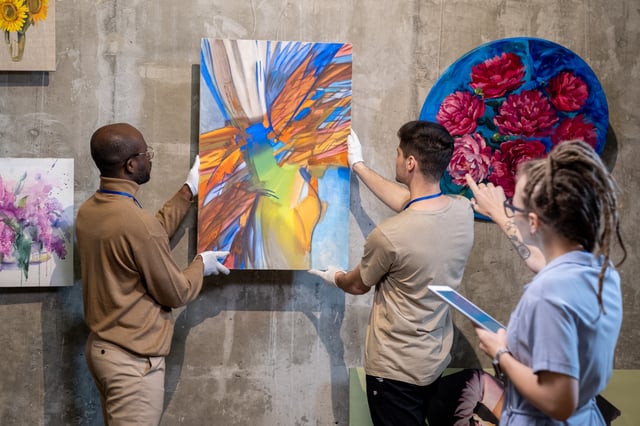
A courier carefully oversees museum staff as they use specialized equipment, such as pallet-jacks or gantries for rigging, to maneuver and place the artwork in its designated gallery location. After installation, the courier checks to verify the piece is stable, damage free, and in compliance with the required display standards.
A fine art courier’s hands-on approach adds security and peace of mind
A courier helps preserve the condition and value of your artwork by making sure no one takes shortcuts during packing, shipping, or installation. The role often requires in-the-moment problem solving in response to unexpected events. One particular area of vulnerability is palletizing art for air travel. Your courier checks that nothing live or liquid travels on the same pallet with the art. They inspect the pallet wrapping to confirm contents can’t shift, and their presence means your temperature-sensitive artwork doesn’t sit for hours on a hot tarmac.
Learn more about couriers and insurance for artwork in transit
A Brown & Brown fine art insurance and risk management specialist can help you assess the necessity and suitability of a courier for your specific needs. They also can acquire appropriate insurance coverage for the transportation process. If you have questions or need more information, you can reach a specialist through our secure contact form.
About the author
Mary Pontillo works extensively with museums and large private/foundation collections to provide risk management advice specific to fine art loans. She arranges contract and transportation reviews to help prevent fine art losses. These often involve evaluating fine art courier requirements.