


.jpg?width=230&height=32&name=BBRetail001-CMYK%20(1).jpg)

Brown & Brown’s PharmaLogic® Spotlight communications review evolving pharmacy dynamics and trends driving prescription drug use and cost to guide benefits decision-making.
New Drug Approvals Influencing Pharmacy Benefits
Through the first half of 2026, the FDA has approved twenty-three new drugs and two gene/cell therapies. Early use of several new drugs including Lifyorli™, Icotyde™, Foundayo™, Yuviwel™ and Baxfendy™, has already been identified in PharmaLogic® data.
FDA approval of CagriSema™ is anticipated by the end of 2026 for the treatment of obesity and diabetes. This new drug combines semaglutide, a GLP-1, with cagrilintide, an amylin agonist, in a weekly injection.
See a listing of key drugs recently approved and those with anticipated approval later this year.
FDA Approved YTD 2026 |
|
|
Weight Loss |
|
|
Cancer |
|
|
Inflammatory Conditions |
|
|
Anti-Infectives and Antivirals |
|
|
Cardiovascular |
|
|
Diabetes |
|
|
Endocrine / Metabolic and other Rare Diseases |
|
|
Mental Health |
|
Drugs Pending FDA Review
-
GLP-1s
-
Weekly insulin
-
Gene therapies
-
Cancer therapies
-
Hemophilia therapy
-
Multiple sclerosis therapy
-
Narcolepsy treatments
-
Non-stimulant drug for ADHD
-
Oral PCSK9 drug for lipid lowering
-
Parkinson’s disease treatment
-
New smoking cessation therapy
-
Drug for stroke prevention
- Myasthenia gravis treatment
Shift in Use of Anti-Inflammatory Drugs
Treatment of inflammatory conditions has shifted over time from drugs that broadly suppress immune responses to newer biologics that are more targeted and precise, blocking specific inflammatory processes in the body. Recent and widespread adoption and use of newer biosimilar options for Humira®, Remicade®, and Stelara® has lowered the cost of these anti-inflammatory therapies.
These shifts are occurring as more patients begin and continue therapy for inflammatory conditions affecting the joints and muscles, digestive system, skin, lungs and other systemic conditions.
|
Type |
Inflammatory Conditions |
|
Joints and Muscles |
|
|
Digestive System |
|
|
Skin and Hair |
|
|
Lungs |
|
|
Other |
|
What Is Causing the Changes in Use of Anti-Inflammatory Drugs in Prescription Benefits?
- Introduction and use of more biosimilar options for Humira® and Stelara®
- Shift in prescribing to newer options such as Skyrizi®, Dupixent®, and Rinvoq®
- Approval of new indications or uses for this class of drugs
- Increasing utilization as new patients begin therapy
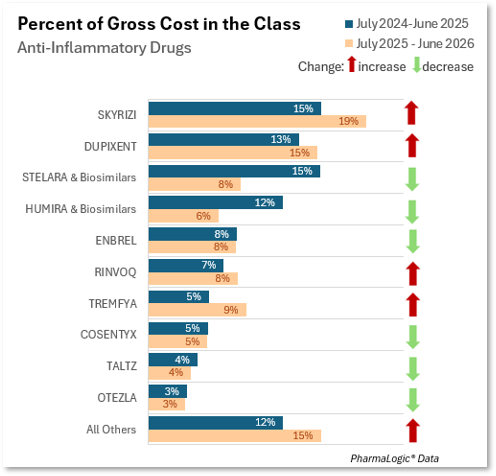
Recently the overall cost trend in this class of drugs has been more moderate than in years past. In fact, some plans have experienced negative cost trends during the past year. Lower trends are related, in large part, to the increased use of lower cost biosimilars offsetting some of the new use of costlier brand products.
Treatments will continue to evolve as research presents new options with additional precision and ways to reprogram a patient’s immune system to deal with disruptive, and often devastating, inflammatory conditions.
Biosimilars Continue to Influence Pharmacy Benefit Costs
The availability of new biosimilar options continues to offer savings to plans in several key, specialty drug classes. While anti-inflammatory biosimilars have generated significant savings, biosimilars in oncology, hematologic/blood conditions, ophthalmic/eye disorders, multiple sclerosis and osteoporosis are also contributing to lower costs.
New biosimilars for Simponi® and Xolair® are expected to be available in 2026.
-
Xolair® is indicated to treat asthma, rhinosinusitis, food allergies and urticaria (itching)
-
Simponi® is indicated to treat rheumatoid arthritis, psoriatic arthritis, ankylosing spondylitis and ulcerative colitis
The Specialty Biosimilar Substitution Rate has increased dramatically during the past three years.
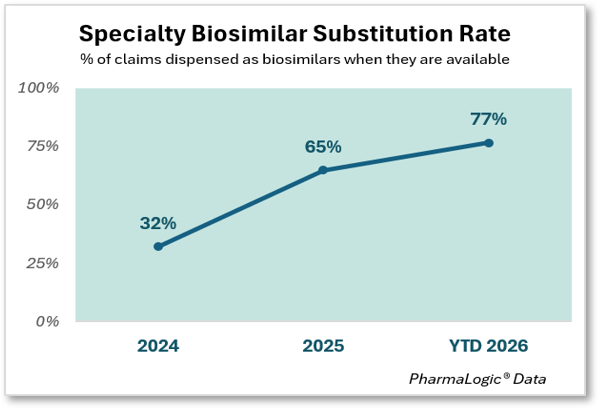
Formulary strategies preferring biosimilars and generics and excluding coverage of original brands that have lost patent protection are key to achieving savings.
Oncology Therapies Shifting Into Prescription Benefits
Oncology drug therapy continues to shift into prescription benefits as more oral drugs become available and maintenance therapies are used to sustain remission and reduce the likelihood of cancer recurrence. A review of medical claims will reveal additional oncology drug costs, largely injectable.
For YTD 2026, Oncology drugs represent the fourth largest therapy class by cost and account for 8.1% of gross cost in prescription benefits monitored by PharmaLogic®. Almost 97% of oncology drug costs are related to oral drug products in prescription benefits.
Top 5 Oncology Drugs in Rx Benefits PharmaLogic® Data, YTD 2026
- Kisqali®
- lenalidomide (generic for Revlimid®)
- Verzenio®
- Xtandi®
- Jakafi®
Employers should leverage formulary management strategies, manufacturer assistance programs, biosimilars, and specialty pharmacy services to help mitigate cost of oncology therapies.
Daraxonrasib, an investigational drug to treat pancreas cancer, has shown promising results in clinical trials.
GLP-1s Therapy Trends
New oral GLP-1 options — FoundayoTM and oral Wegovy® — have entered the weight loss market and are contributing to continued growth in utilization. Some patients who previously avoided injectable GLP-1s have begun therapy, adding to utilization and costs. New patients have also started injectable Wegovy® and Zepbound® therapies.
Research continues to develop weight loss options that are more effective with convenient dosage forms and fewer adverse effects.
- FDA approval of CagriSemaTM is anticipated by the end of the year. This new drug combines semaglutide, a GLP-1, with cagrilintide, an amylin agonist, in a weekly injection.
- Retatrutide, an investigational injectable therapy with a brand name still pending, remains in late-stage clinical trials and is expected to be submitted to the FDA for review in 2027.
Continued increases in utilization create challenges for benefit managers who struggle to sustain coverage of weight loss GLP-1 drugs. Some plans have made difficult decisions to exclude coverage and advise members to consider manufacturer direct-to-consumer options. Most benefits still covering these drugs require prior authorization, enrollment in a behavioral nutrition program for coverage or increased patient copays. Medicare/ Medicaid will provide access to GLP-1s through their BALANCE model pilots and programs.
Thus far in 2026, more than 60% of individuals using oral Wegovy® or Foundayo™ are new to weight loss GLP-1 therapy and had not used an injectable weight loss GLP-1 during the previous 12 months.
Use of oral GLP-1 options is expected to grow as they gain preferred formulary status.
Source: PharmaLogic® Data YTD 2026
Unit pricing for GLP-1s is gradually improving as competition grows, and manufacturers strive to maintain and grow market share of their products. One major PBM who previously excluded Zepbound® from its formulary plans to restore coverage later this year following negotiations intended to reduce net costs.
Perimenopausal Drug Therapy Continues to Evolve
Perimenopause is the natural phase leading up to menopause when a woman’s ovaries make less estrogen. The hormone changes during this time often cause disruptive physical and emotional symptoms that may include menstrual cycle changes, hot flashes, night sweats, sleep disturbances, mood changes and other quality-of-life impacts. Lower estrogen levels are also associated with an increased risk of osteoporosis and increased LDL (poor) cholesterol levels.
Hormone and Non-Hormonal Treatment Options
Hormone therapy has been used for years during perimenopause to increase estrogen and progesterone levels and relieve symptoms. In 2025, the FDA removed most warnings associated with hormone replacement products that had been in place since 2003. Many hormone replacement therapies have been available for years and are widely used as low-cost generic medications. As a result, traditional hormone therapy generally has a minimal impact on prescription benefit costs compared to many new brand-name therapies.
New non-hormonal therapies for menopause symptoms — including Veozah® and Lynkuet® — have expanded treatment options for individuals who prefer to avoid hormone therapy.
About PharmaLogic®
PharmaLogic® is Brown & Brown’s proprietary pharmacy data analytics platform that enables millions of dollars of annual financial savings and provides intelligent clinical analytics that positively impact individual medication access and improve overall population health. PharmaLogic® is leveraged for PBM contract modeling, PBM RFPs and/or negotiation, ongoing claims monitoring, advocacy and management, and consulting services to ensure that customers understand plan design, trends, forecasts, and issues that impact spend and population management.
Brown & Brown is ready to assist you as you face new prescription benefit challenges and contemplate benefit changes and potential solutions. Together, we can review strategies with PBMs, including optimizing formulary incentives to support biosimilar use and utilization and behavioral management related to new and continuing drug therapies.
Connect with our team