



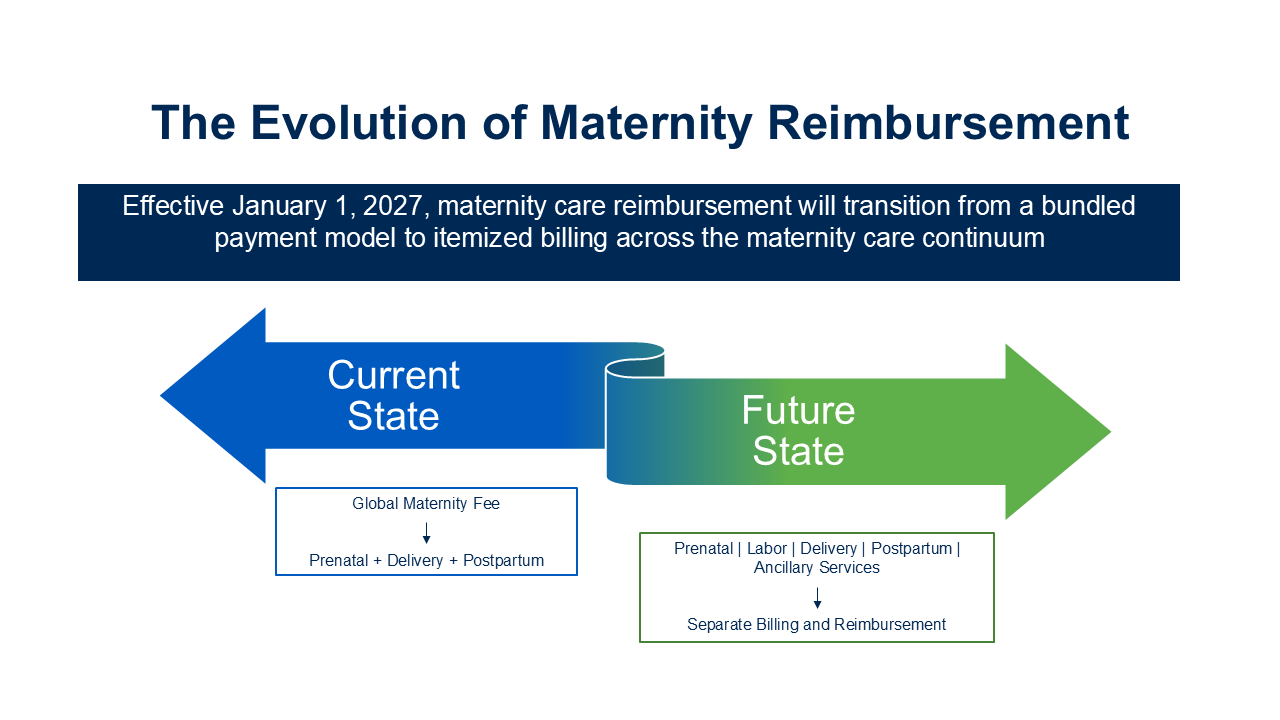
Effective January 1, 2027, American College of Obstetricians and Gynecologists (ACOG) and the American Medical Association (AMA) will eliminate and replace several global obstetric codes, transitioning maternity care from a bundled payment model to unbundled (itemized) billing across the maternity continuum. Each maternity phase including prenatal, labor, delivery, postpartum, and certain ancillary services (e.g., genetic counseling, depression screenings), will be billed separately rather than under a single global maternity fee. Although on the surface, this may sound like a simple coding change its impact extends beyond claims administration.
Why the billing change matters for employer health plans
Maternity remains one of the top healthcare cost drivers for many employer health plans. The transition to itemized billing is intended to improve pricing transparency and better align reimbursement with the intensity of care delivered. From an employer perspective, the change will create greater visibility into utilization patterns, care pathways, and outcomes. However, it may also introduce new challenges related to cost predictability, claims administration, and care coordination.
Potential challenges for employers during the transition
As adaptation to the new coding framework occurs, employers should be prepared for several potential challenges during the transition period:
- Greater cost volatility and difficulty forecasting total maternity episode costs
- Increased administrative complexity and potential billing errors as providers and payors adapt
- Risk of care fragmentation due to separate billing across the maternity journey
- Potential changes to prior authorization processes for routine deliveries
- Operational uncertainty surrounding areas such as midwife and birthing centers reimbursement
- Unique billing considerations for pregnancies that span the 2026–2027 transition period
- Possible maternity benefit adjustments as the market evolves
Maternity program capabilities employers can evaluate
This change presents a significant opportunity for employers to strengthen their maternity health strategy. Employers should consider if their current maternity ecosystem is positioned to:
- Identify high-risk pregnancies earlier and reassess risk stratification throughout pregnancy
- Support longitudinal care management across the prenatal, delivery, and postpartum periods
- Address gaps in care navigation, case management, behavioral health support, and postpartum engagement
- Measure clinical outcomes (not simply utilization)
- Leverage more granular claims data to evaluate quality, cost, and program effectiveness
What employers can do now
Although final implementation guidance is still evolving, employers should not wait to begin preparing. Here are some immediate actions employers can take:
Analytics and reporting
- Enhance data and reporting capabilities to support itemized claims analysis
- Track costs, utilization, quality, and outcomes at a more granular level
- Monitor coding integrity (upcoding), variations in care patterns, and intensity
Cost management
- Reassess reimbursement strategies, network arrangements, and pricing models
- Monitor market developments and lessons learned from early adopters
- Prepare for increased complexity in forecasting and budgeting maternity spend
Looking ahead as 2027 guidance develops
The 2027 maternity coding change is more than a reimbursement update. It signals a broader shift toward greater transparency, accountability, and outcome measurement in maternal health. Employers that invest in enhanced risk identification, care navigation, and comprehensive maternity capabilities will be better positioned to manage cost, improve the member experience, and drive better clinical outcomes.
Currently, the financial impact of these coding changes remains uncertain pending the release of final coding, reimbursement, and implementation guidance. The effect on maternity episode costs, provider billing practices, employer plan spend, and reimbursement methodologies will become clearer as additional guidance is issued, and the market adapts to the new billing framework.
Resources
- ACOG Payment for Obstetric Services: Payment for Obstetric Services | ACOG
- AMA: A Health Plan Primer: Previewing the CPT 2027 Restructure for Maternity Care Services (Includes a 1:28-hour webinar recording and the77 page slide deck PDF)
- AMA: 2027 Maternity Care Services Code Changes
About the author
Yolanda Williams is a Managing Clinical Consultant at Brown & Brown, bringing extensive experience across diverse healthcare settings, including acute care, women’s health, and clinical consulting for mid-sized and large customers. Her areas of specialty encompass the development of care management programs, strategic wellbeing initiatives, and clinical evaluation of medical, behavioral health, and chronic condition management solutions. Yolanda holds a Bachelor of Science in Nursing from Georgia Baptist College of Nursing at Mercer University.